

Skip to content
PrepShark

Chapter 7Ancient Indian History and CultureUpdated

Post-Mauryan India: Indigenous and Foreign Dynasties, Trade and Art

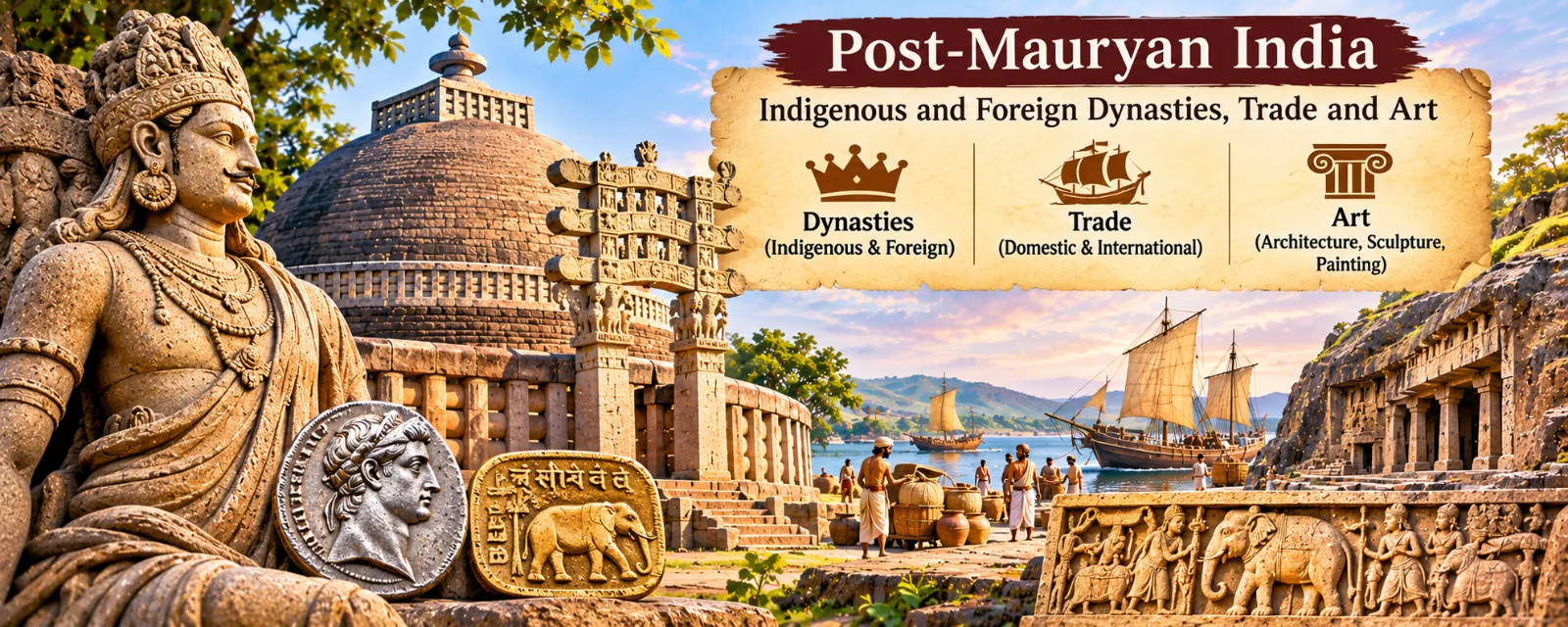
How Shungas, Kanvas, Indo-Greeks, Shakas, Western Kshatrapas, Indo-Parthians, Kushans and Kharavela ruled side by side, and how trade, coins, religion and the art of Bharhut, Sanchi, Gandhara and Mathura grew around them.

  • 21sections
  • ~108min read
0%

0 of 25 sections

~108 min read

~108 min read

Start hereAbout 1 min

Chapter Overview Map

In this section: 1 mind map

Figure 7.1Chapter overview: how the sections connect
Post-Mauryan India (c. 185 BCE – c. 250 CE)
  1. 7.1–7.2 Setting and sources

    • After about 185 BCE many dynasties ruled at the same time in different regions, not one after another.
    • Coins and inscriptions carry most of the story because written histories are few.
  2. 7.3–7.4 and 7.18 Indian kingdoms

    • Shungas and Kanvas held Magadha and central India; Kharavela made Kalinga a regional power.
  3. 7.5–7.10 Rulers from the north-west

    • Indo-Greeks, Shakas, Western Kshatrapas, Indo-Parthians and Kushans entered from Bactria, Iran and Central Asia.
    • Kanishka linked Central Asia with the Ganga plain.
  4. 7.11–7.17 Trade, religion and art

    • Silk Routes and Indian Ocean trade brought wealth; coins became richer and more varied.
    • Buddhism, Jainism and Bhagavata worship grew through royal and merchant donations.
    • Bharhut and Sanchi show stone narrative relief; Gandhara and Mathura created early Buddha images.
  5. 7.19–7.21 Society, Deccan links and legacy

    • Merchants, guilds and women donors became visible; Deccan routes tied the north to Andhra and Telangana.
  6. Don't confuse

    • Coin finds show circulation or trade; they do not by themselves prove political rule over the place where they are found.

The branches move from political history to economy, religion and art. Notice the warning branch: evidence of contact is not evidence of conquest.

Inside this chapter

What Post-Mauryan India: Indigenous and Foreign Dynasties, Trade and Art covers

  1. Chapter Overview Map
  2. Historical Background and Chronological Framework
  3. Sources for Post-Mauryan History
  4. The Shunga Dynasty
  5. The Kanva Dynasty
  6. The Indo-Greeks
  7. The Shakas (Indo-Scythians)
  8. The Western Kshatrapas
  9. The Indo-Parthians
  10. The Kushan Empire
  11. Kanishka: Power, Religion and Patronage
  12. Silk Routes, Indo-Roman Trade and Economic Change
  13. Post-Mauryan Coinage
  14. Religious and Philosophical Developments
  15. Post-Mauryan Art: Stupas, Bharhut and Sanchi
  16. The Gandhara School of Art
  17. The Mathura School of Art
  18. Gandhara, Mathura and Amaravati Compared
  19. Kharavela and Kalinga
  20. Society, Economy and Cultural Interaction
  21. Andhra Pradesh and Telangana Connections
  22. Decline, Transformation and Legacy
  23. Location and Map Practice
  24. Memory and Recall Review
  25. Rapid Revision Sheet
All 46 chapters in Indian History
  1. Sources of Ancient Indian History and Prehistoric Cultures
  2. Indus Valley Civilisation
  3. Vedic Age: Society, Polity, Religion and Literature
  4. Mahajanapadas, Second Urbanisation and Rise of Magadha
  5. Jainism, Buddhism and Other Religious and Philosophical Traditions
  6. Mauryan Empire: Administration, Society, Economy and Culture
  7. Post-Mauryan India: Indigenous and Foreign Dynasties, Trade and Art
  8. Satavahanas, Ikshvakus and Early Deccan Culture
  9. Sangam Age and Early South Indian History and Culture
  10. Gupta Empire, Vakatakas and the Classical Age of Indian Culture
  11. Post-Gupta India, Harsha and the Transition to Early Medieval India
  12. Ancient Indian Society, Economy, Education, Science and Knowledge Systems
  13. Ancient Indian Architecture, Performing Arts and Cultural Heritage: Thematic Synthesis
  14. Early Medieval India: Political, Social and Economic Transformations
  15. Palas, Pratiharas, Rashtrakutas and the Tripartite Struggle
  16. Pallavas and Chalukyas: Early South Indian Kingdoms and Culture
  17. Rashtrakutas, Western Chalukyas, Hoysalas and Yadavas
  18. Imperial Cholas, Pandyas and Medieval South Indian Culture
  19. Kakatiyas, Reddis, Gajapatis and Other Regional Kingdoms
  20. Advent of Islam and the Delhi Sultanate: Political History
  21. Delhi Sultanate: Administration, Society, Economy and Culture
  22. Vijayanagara Empire and the Bahmani–Deccan Sultanates
  23. Bhakti, Sufi and Religious Reform Movements in Medieval India
  24. Mughal Empire: Establishment, Expansion and Decline
  25. Mughal Administration, Economy, Society and Cultural Achievements
  26. Marathas, Sikhs and the Rise of Regional Powers in the Eighteenth Century
  27. Medieval Indian Society, Literature, Fine Arts and Composite Culture: Thematic Synthesis
  28. Arrival of Europeans
  29. Rise of Regional States
  30. British Conquest of India
  31. Popular Uprisings Before 1857
  32. 1857 Revolt
  33. Popular Uprisings After 1857
  34. Socio-Religious Reform Movements
  35. Beginning of Struggle (1805-1905)
  36. National Movement (1905-1919)
  37. National Movement (1919-1929)
  38. National Movement (1929-1947)
  39. Economic Impact of British Rule in India
  40. LAND REVENUE SYSTEM IN INDIA
  41. DEVELOPMENT OF EDUCATION SYSTEM AND LANGUAGE IN INDIA
  42. DEVELOPMENT OF PRESS
  43. OTHER ASPECTS OF BRITISH RULE IN INDIA
  44. GOVERNOR GENERAL OF INDIA (1773-1950)
  45. IMPORTANT JOURNALS AND BOOKS
  46. IMPORTANT PERSONALITIES

Open the Indian History library

In the official syllabus