

Start hereAbout 2 min
Chapter Overview Map
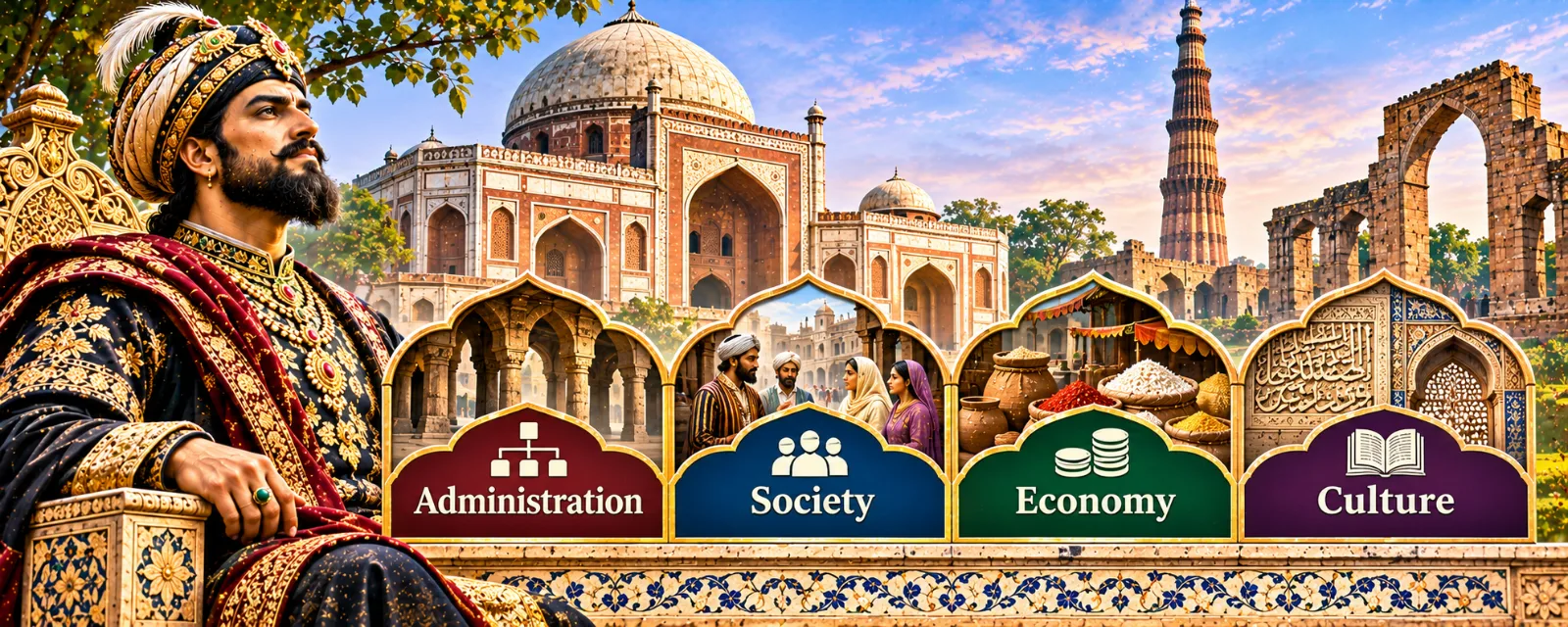
Delhi Sultanate: administration, society, economy and culture
8.1–8.5 State and administration
- The Sultanate was a changing system from 1206 to 1526, not one uniform government.
- Its authority rested on military power, revenue, court ceremony and religious patronage.
- Central diwans (departments) handled finance, army, correspondence, justice and intelligence.
- Provinces and villages were governed through muqtis, amils, shiqdars, muqaddams and chaudhuris.
8.6–8.11 Revenue, army and reforms
- The iqta was a revenue assignment held for service, not private ownership of land.
- Khalisa land paid its revenue directly to the royal treasury.
- Alauddin Khalji combined land measurement, a high revenue demand and price control to pay a large cash army.
- Muhammad bin Tughlaq and Firuz Shah Tughlaq tried very different fiscal and public-works policies.
8.12–8.13 Economy and society
- The silver tanka and the low-value jital supported a money economy for taxes, salaries and trade.
- Towns such as Delhi, Lahore, Multan, Jaunpur and Ahmedabad grew as political and commercial centres.
- Society was diverse and unequal: nobles, scholars, merchants, artisans, peasants and enslaved people.
- Court chronicles say little about women outside the elite, so evidence must be read carefully.
8.14–8.15 Religion, learning and literature
- Chishti and Suhrawardi khanqahs became centres of devotion, teaching and social contact.
- Persian became the main language of the court and administration.
- Chronicles by Minhaj, Barani, Isami and Afif are vital but written from the court's point of view.
8.16–8.18 Architecture and cities
- Builders moved from corbelled arches in the 1190s to true arches by about 1287 and true domes in the Alai Darwaza (1311).
- Delhi grew through successive centres: Mehrauli, Siri, Tughlaqabad, Jahanpanah and Firozabad.
- Regional sultanates at Jaunpur, Pandua, Ahmedabad and Mandu developed their own styles.
Don't confuse
- An iqta was an assignment of revenue; khalisa was land whose revenue went straight to the treasury.
- A muqti held an iqta; a muqaddam was a village headman.
- Two works share the title Tarikh-i Firuz Shahi: one by Barani, one by Afif.
- Siri was Alauddin's city; Tughlaqabad was Ghiyasuddin Tughlaq's; Jahanpanah was Muhammad bin Tughlaq's.
Notice how revenue and the army sit at the heart of the map: administration, reforms, cities and even buildings depended on them. The last branch gathers confusions that cross sections.