

Skip to content
PrepShark

Chapter 2Medieval Indian History & CultureUpdated

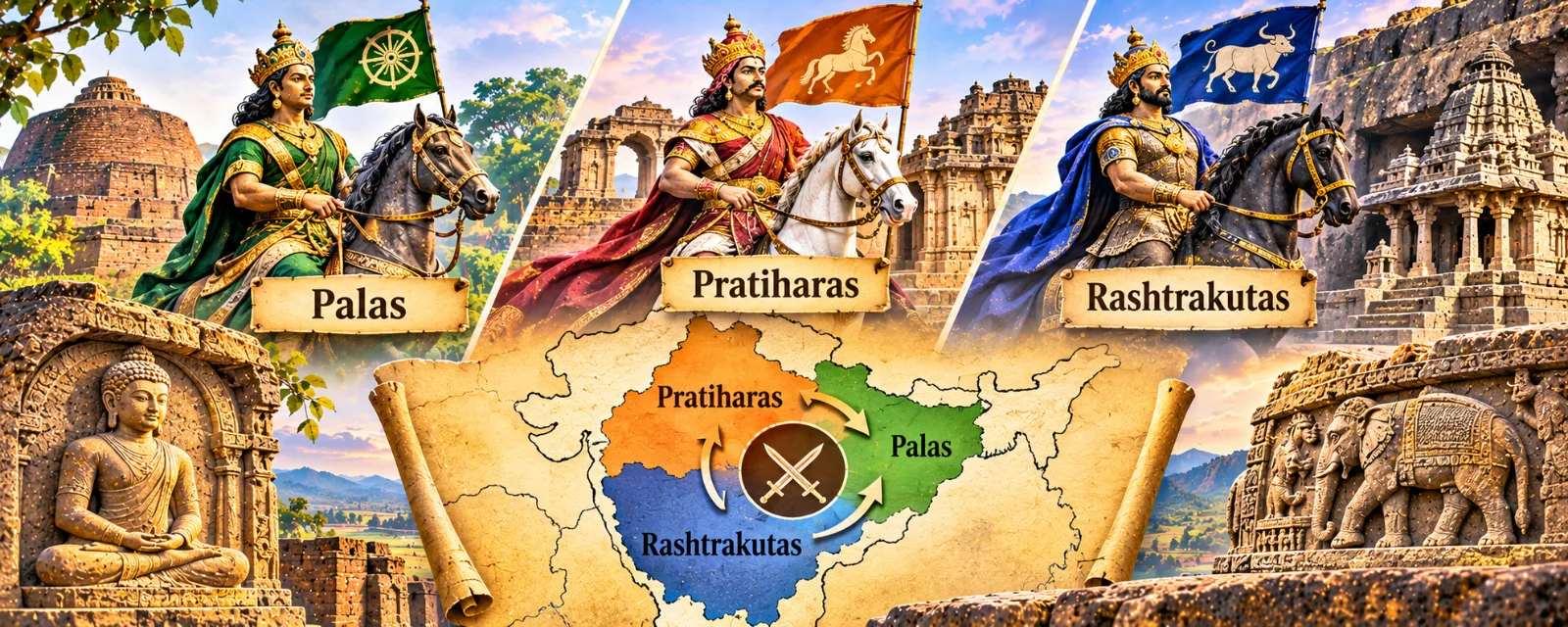
Palas, Pratiharas, Rashtrakutas and the Tripartite Struggle

How three regional empires rose in Bengal, western India and the Deccan, contested Kanauj, governed through feudatories and land grants, and built monasteries, temples and literatures, with their links to Andhra Pradesh and Telangana.

  • 23sections
  • ~121min read
0%

0 of 27 sections

~121 min read

~121 min read

Start hereAbout 2 min

Chapter Overview Map

In this section: 1 mind map

Figure 2.1Chapter overview: three dynasties and their contest
Palas, Pratiharas, Rashtrakutas and the Tripartite Struggle
  1. 2.1–2.2 Setting and sources

    • After Harsha (died 647 CE), north India broke into regional kingdoms; no single power held the Ganga valley for long.
    • Copper-plate grants, prashastis, coins, monuments and Arab accounts are the main evidence, and each has limits.
  2. 2.3–2.7 Palas of Bengal and Bihar

    • Gopala rose out of matsyanyaya (disorder); Dharmapala and Devapala made the Palas an eastern imperial power.
    • The Palas patronised Nalanda, Vikramashila and Somapura, and an influential eastern school of sculpture.
  3. 2.8–2.10 Gurjara-Pratiharas

    • From Avanti and western India, Nagabhata II took Kanauj, and Mihira Bhoja made it the centre of a large northern state.
    • Their age saw Nagara temples (Osian, Gwalior) and the poet Rajasekhara.
  4. 2.11–2.16 Rashtrakutas of the Deccan

    • Dantidurga overthrew the Badami Chalukyas; Krishna I is credited with the Kailasa Temple at Ellora.
    • Dhruva, Govinda III and Indra III raided the Ganga valley; Amoghavarsha I ruled from Manyakheta and patronised Kannada and Jain learning.
  5. 2.17–2.19 The Tripartite Struggle

    • A series of separate campaigns (about 780–830 CE at its core) for influence over Kanauj and the middle Ganga valley.
    • Victories brought tribute and prestige, but rarely permanent annexation.
  6. 2.20–2.22 Comparison and regional links

    • Three samanta-based monarchies with different religious and artistic profiles.
    • Rashtrakuta wars with Vengi shaped Andhra; the Vemulavada Chalukyas of Telangana were Rashtrakuta feudatories and patrons of Pampa.
  7. Don't confuse

    • The Pala Mahipala I (Bengal, about 988–1038) is a different king from the Pratihara Mahipala I (Kanauj, about 912–944).
    • Kailasa (Ellora, rock-cut, Rashtrakuta) is not the Kailasanatha (Kanchipuram, structural, Pallava).
    • Vemulavada Chalukyas (Telangana feudatories) are not the Eastern Chalukyas of Vengi (coastal Andhra).

Notice how the branches move from setting and sources, through each dynasty, to the contest and its regional links; the last branch holds three costly confusions.

Inside this chapter

What Palas, Pratiharas, Rashtrakutas and the Tripartite Struggle covers

  1. Chapter Overview Map
  2. India after Harsha: Setting, Geography and Chronology
  3. Sources for the Three Dynasties
  4. The Palas: Gopala, Dharmapala and Devapala
  5. Later Palas: Decline, Revival and the Senas
  6. Pala Administration, Society and Economy
  7. Pala Religion and Buddhist Learning
  8. Pala Art: Sculpture, Bronzes, Painting and Architecture
  9. The Gurjara-Pratiharas: Origins to Nagabhata II
  10. Mihira Bhoja, Mahendrapala I and the Later Pratiharas
  11. Pratihara Administration, Economy, Temples and Literature
  12. The Rashtrakutas: Origins, Dantidurga and Krishna I
  13. Dhruva, Govinda III and Amoghavarsha I
  14. Later Rashtrakutas: Krishna II to the Fall of Manyakheta
  15. Rashtrakuta Administration, Society and Economy
  16. Ellora and the Kailasa Temple
  17. Rashtrakuta Religion, Kannada and Jain Literature
  18. The Tripartite Struggle: Meaning, Causes and Kanauj
  19. The Tripartite Struggle: Phase-wise Chronology
  20. Consequences and Historical Significance
  21. Comparing the Three Dynasties
  22. Andhra Pradesh Connections: The Rashtrakutas and Vengi
  23. Telangana Connections: The Vemulavada Chalukyas
  24. High-Yield Reference: Records, Monuments, Texts and Traps
  25. Location and Map Practice
  26. Memory and Recall Review
  27. Rapid Revision Sheet
All 46 chapters in Indian History
  1. Sources of Ancient Indian History and Prehistoric Cultures
  2. Indus Valley Civilisation
  3. Vedic Age: Society, Polity, Religion and Literature
  4. Mahajanapadas, Second Urbanisation and Rise of Magadha
  5. Jainism, Buddhism and Other Religious and Philosophical Traditions
  6. Mauryan Empire: Administration, Society, Economy and Culture
  7. Post-Mauryan India: Indigenous and Foreign Dynasties, Trade and Art
  8. Satavahanas, Ikshvakus and Early Deccan Culture
  9. Sangam Age and Early South Indian History and Culture
  10. Gupta Empire, Vakatakas and the Classical Age of Indian Culture
  11. Post-Gupta India, Harsha and the Transition to Early Medieval India
  12. Ancient Indian Society, Economy, Education, Science and Knowledge Systems
  13. Ancient Indian Architecture, Performing Arts and Cultural Heritage: Thematic Synthesis
  14. Early Medieval India: Political, Social and Economic Transformations
  15. Palas, Pratiharas, Rashtrakutas and the Tripartite Struggle
  16. Pallavas and Chalukyas: Early South Indian Kingdoms and Culture
  17. Rashtrakutas, Western Chalukyas, Hoysalas and Yadavas
  18. Imperial Cholas, Pandyas and Medieval South Indian Culture
  19. Kakatiyas, Reddis, Gajapatis and Other Regional Kingdoms
  20. Advent of Islam and the Delhi Sultanate: Political History
  21. Delhi Sultanate: Administration, Society, Economy and Culture
  22. Vijayanagara Empire and the Bahmani–Deccan Sultanates
  23. Bhakti, Sufi and Religious Reform Movements in Medieval India
  24. Mughal Empire: Establishment, Expansion and Decline
  25. Mughal Administration, Economy, Society and Cultural Achievements
  26. Marathas, Sikhs and the Rise of Regional Powers in the Eighteenth Century
  27. Medieval Indian Society, Literature, Fine Arts and Composite Culture: Thematic Synthesis
  28. Arrival of Europeans
  29. Rise of Regional States
  30. British Conquest of India
  31. Popular Uprisings Before 1857
  32. 1857 Revolt
  33. Popular Uprisings After 1857
  34. Socio-Religious Reform Movements
  35. Beginning of Struggle (1805-1905)
  36. National Movement (1905-1919)
  37. National Movement (1919-1929)
  38. National Movement (1929-1947)
  39. Economic Impact of British Rule in India
  40. LAND REVENUE SYSTEM IN INDIA
  41. DEVELOPMENT OF EDUCATION SYSTEM AND LANGUAGE IN INDIA
  42. DEVELOPMENT OF PRESS
  43. OTHER ASPECTS OF BRITISH RULE IN INDIA
  44. GOVERNOR GENERAL OF INDIA (1773-1950)
  45. IMPORTANT JOURNALS AND BOOKS
  46. IMPORTANT PERSONALITIES

Open the Indian History library

In the official syllabus