

Skip to content
PrepShark

Chapter 8Ancient Indian History and CultureUpdated

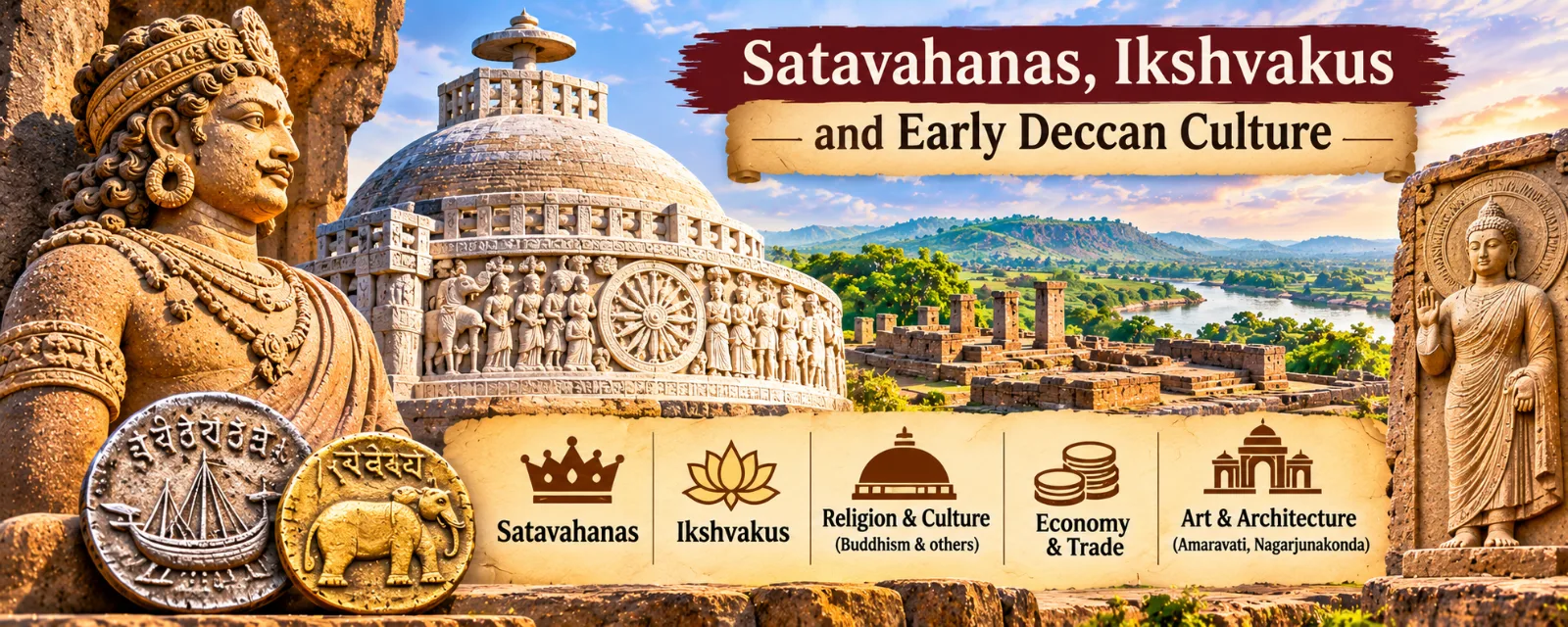
Satavahanas, Ikshvakus and Early Deccan Culture

Sources, origins and rulers of the Satavahanas, their administration, society, economy, coinage, trade, religion and Prakrit literature, the art of the Deccan caves and Amaravati, the sites of Andhra Pradesh and Telangana, and the Ikshvakus of Nagarjunakonda.

  • 24sections
  • ~151min read
0%

0 of 28 sections

~151 min read

~151 min read

Start hereAbout 2 min

Chapter Overview Map

In this section: 1 mind map

Figure 8.1Mind map: Satavahanas, Ikshvakus and Early Deccan Culture
Satavahanas, Ikshvakus and Early Deccan Culture
  1. 8.1–8.3 Setting, sources and origins

    • The Deccan's river valleys and passes made it a bridge between north and south India.
    • Inscriptions, coins and archaeology are firmer evidence than the later Puranic king-lists.
    • The dynasty's original home and early dates are debated; no single view is settled.
  2. 8.4–8.6 Satavahana political history

    • Simuka, Kanha and Satakarni I built the early state; Queen Naganika recorded its Vedic sacrifices.
    • Gautamiputra Satakarni defeated Nahapana and restored the dynasty in the western Deccan.
    • Pulumavi and Yajna Sri held the Krishna valley; the main line ended in the 220s CE.
  3. 8.7–8.9 State, society and economy

    • Kings ruled through amatyas, aharas and hereditary Maharathis and Mahabhojas.
    • Royal names such as Gautamiputra came from mothers' clan names, but succession passed through sons.
    • Guilds (shrenis) took deposits and paid interest, and their members were leading donors.
  4. 8.10–8.13 Coins, trade, religion and Prakrit

    • Lead, potin, copper and silver coins; portrait and ship types; no gold coins.
    • The Periplus and Ptolemy describe Deccan marts linked to Roman trade.
    • Kings performed Vedic sacrifices and also gave caves and villages to Buddhist monks.
    • Prakrit in Brahmi was the inscriptional language; Hala's Gatha Saptashati is the literary landmark.
  5. 8.14–8.17 Art, Amaravati and regional sites

    • Rock-cut chaityas and viharas in the western Deccan; limestone stupas in the lower Krishna valley.
    • The Amaravati School grew in phases and is famed for crowded, moving narrative relief.
    • Andhra Pradesh and Telangana hold sites from Bhattiprolu and Amaravati to Kotilingala and Phanigiri.
  6. 8.18–8.21 Decline, Ikshvakus and Nagarjunakonda

    • After Yajna Sri the empire split among Ikshvakus, Abhiras, Chutus and others.
    • The Ikshvakus of Vijayapuri ruled the lower Krishna valley in the 3rd and early 4th centuries CE.
    • Royal women such as Chamtisiri paid for most Buddhist buildings at Nagarjunakonda.
  7. 8.22–8.24 Synthesis and transition

    • Amaravati and Nagarjunakonda are two stages of one lower Krishna valley tradition.
    • Agricultural surplus, trade and patronage together funded Deccan culture.
    • Brihatphalayanas, Anandas and Shalankayanas prepared the way for the Vishnukundins.
  8. Don't confuse

    • Gautamiputra Satakarni was the king; Gautami Balashri was his mother, who issued the Nasik prashasti.
    • Nagarjunakonda is the Ikshvaku site in the Krishna valley; the Nagarjuni caves are Mauryan caves in Bihar.
    • Kotilingala is an important early site; its claim to be the first capital is not proven.

Notice that branches follow the chapter's sections in order; the last branch gathers the confusions met most often.

Inside this chapter

What Satavahanas, Ikshvakus and Early Deccan Culture covers

  1. Chapter Overview Map
  2. Early Deccan and the Emergence of Satavahana Power
  3. Historical Sources for the Satavahanas and Ikshvakus
  4. Origin, Chronology and Territorial Extent of the Satavahanas
  5. Early Satavahana Rulers and Political Consolidation
  6. Gautamiputra Satakarni: Political Achievements and Historical Significance
  7. Vashishthiputra Pulumavi and Later Satavahana Rulers
  8. Satavahana Administration and Political Institutions
  9. Satavahana Society, Social Structure and Women
  10. Satavahana Economy: Agriculture, Revenue and Craft Production
  11. Satavahana Coinage and Numismatic History
  12. Internal Trade, Indo-Roman Commerce and Maritime Connections
  13. Religion and Religious Patronage under the Satavahanas
  14. Satavahana Language, Literature and Intellectual Culture
  15. Satavahana Art, Architecture and Monumental Patronage
  16. Amaravati School of Art: Origin, Development and Characteristics
  17. Important Satavahana and Early Buddhist Sites in Andhra Pradesh
  18. Important Satavahana and Early Historic Sites in Telangana
  19. Decline of the Satavahanas and Emergence of Successor Powers
  20. Ikshvaku Dynasty: Origins, Political History and Administration
  21. Women, Religious Patronage and Social Life under the Ikshvakus
  22. Nagarjunakonda: Buddhist Heritage, Architecture and Sculpture
  23. Amaravati and Nagarjunakonda: Comparative Art and Cultural History
  24. Early Deccan Religion, Literature, Art and Culture: Integrated Synthesis
  25. Successor Dynasties and Transition to Later Ancient Andhra
  26. Location and Map Practice
  27. Memory and Recall Review
  28. Rapid Revision Sheet
All 46 chapters in Indian History
  1. Sources of Ancient Indian History and Prehistoric Cultures
  2. Indus Valley Civilisation
  3. Vedic Age: Society, Polity, Religion and Literature
  4. Mahajanapadas, Second Urbanisation and Rise of Magadha
  5. Jainism, Buddhism and Other Religious and Philosophical Traditions
  6. Mauryan Empire: Administration, Society, Economy and Culture
  7. Post-Mauryan India: Indigenous and Foreign Dynasties, Trade and Art
  8. Satavahanas, Ikshvakus and Early Deccan Culture
  9. Sangam Age and Early South Indian History and Culture
  10. Gupta Empire, Vakatakas and the Classical Age of Indian Culture
  11. Post-Gupta India, Harsha and the Transition to Early Medieval India
  12. Ancient Indian Society, Economy, Education, Science and Knowledge Systems
  13. Ancient Indian Architecture, Performing Arts and Cultural Heritage: Thematic Synthesis
  14. Early Medieval India: Political, Social and Economic Transformations
  15. Palas, Pratiharas, Rashtrakutas and the Tripartite Struggle
  16. Pallavas and Chalukyas: Early South Indian Kingdoms and Culture
  17. Rashtrakutas, Western Chalukyas, Hoysalas and Yadavas
  18. Imperial Cholas, Pandyas and Medieval South Indian Culture
  19. Kakatiyas, Reddis, Gajapatis and Other Regional Kingdoms
  20. Advent of Islam and the Delhi Sultanate: Political History
  21. Delhi Sultanate: Administration, Society, Economy and Culture
  22. Vijayanagara Empire and the Bahmani–Deccan Sultanates
  23. Bhakti, Sufi and Religious Reform Movements in Medieval India
  24. Mughal Empire: Establishment, Expansion and Decline
  25. Mughal Administration, Economy, Society and Cultural Achievements
  26. Marathas, Sikhs and the Rise of Regional Powers in the Eighteenth Century
  27. Medieval Indian Society, Literature, Fine Arts and Composite Culture: Thematic Synthesis
  28. Arrival of Europeans
  29. Rise of Regional States
  30. British Conquest of India
  31. Popular Uprisings Before 1857
  32. 1857 Revolt
  33. Popular Uprisings After 1857
  34. Socio-Religious Reform Movements
  35. Beginning of Struggle (1805-1905)
  36. National Movement (1905-1919)
  37. National Movement (1919-1929)
  38. National Movement (1929-1947)
  39. Economic Impact of British Rule in India
  40. LAND REVENUE SYSTEM IN INDIA
  41. DEVELOPMENT OF EDUCATION SYSTEM AND LANGUAGE IN INDIA
  42. DEVELOPMENT OF PRESS
  43. OTHER ASPECTS OF BRITISH RULE IN INDIA
  44. GOVERNOR GENERAL OF INDIA (1773-1950)
  45. IMPORTANT JOURNALS AND BOOKS
  46. IMPORTANT PERSONALITIES

Open the Indian History library

In the official syllabus