

Skip to content
PrepShark

Chapter 9Medieval Indian History & CultureUpdated

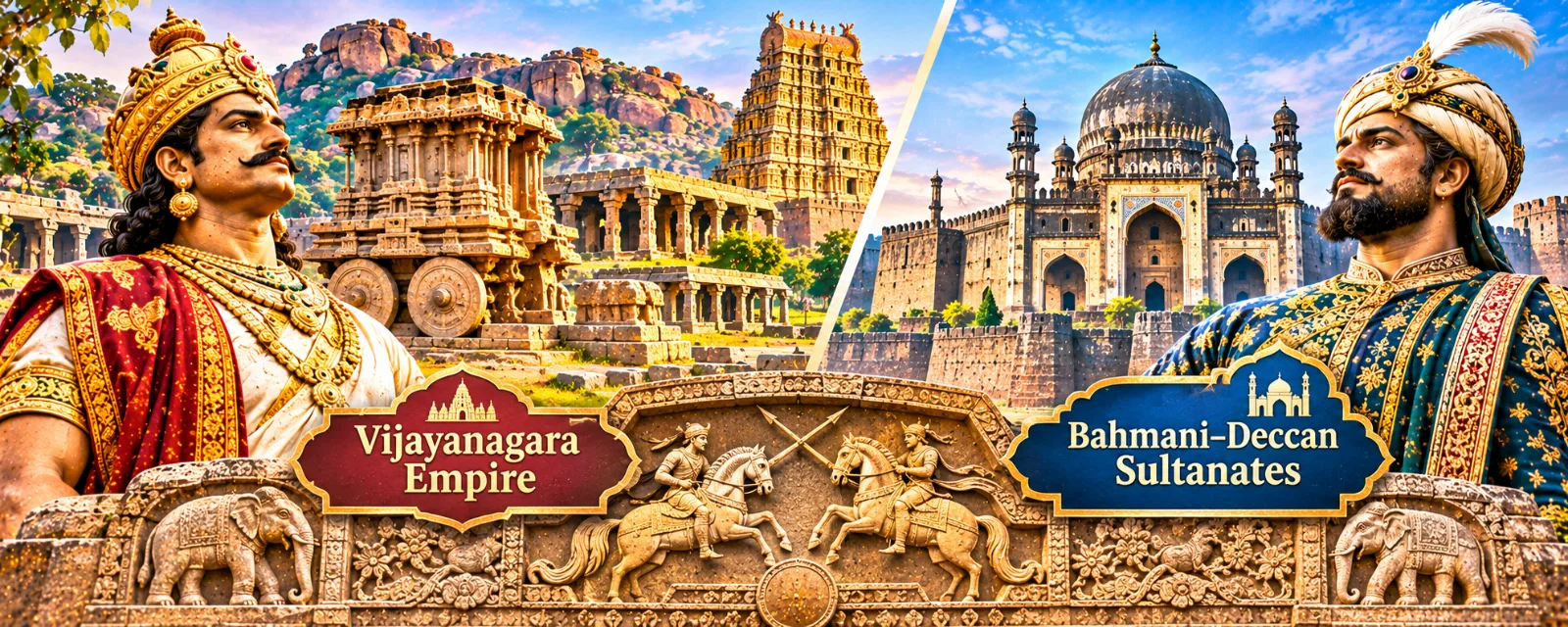
Vijayanagara Empire and the Bahmani–Deccan Sultanates

How Vijayanagara and the Bahmani Sultanate rose in the fourteenth-century Deccan, how their successors ruled, fought and traded until 1687, and what they left in Andhra Pradesh, Telangana and Karnataka.

  • 17sections
  • ~99min read
0%

0 of 21 sections

~99 min read

~99 min read

Start hereAbout 1 min

Chapter Overview Map

In this section: 1 mind map

Figure 9.1Mind map: how the chapter fits together
Vijayanagara and the Bahmani–Deccan Sultanates
  1. 9.1 Setting and sources

    • The Deccan rivers and the Raichur Doab shaped most wars of the period.
    • Inscriptions, Persian chronicles and Portuguese travellers must be read critically.
  2. 9.2–9.4 Vijayanagara's four dynasties

    • Sangama, Saluva, Tuluva and Aravidu ruled from about 1336 to the 1650s.
    • Krishnadevaraya (1509–29) conquered coastal Andhra and won Raichur (1520).
    • Talikota (1565) ended Hampi as capital, not the empire.
  3. 9.5–9.8 How Vijayanagara worked

    • Amaranayakas held territory for troops and tribute.
    • Irrigation, horse imports and temples underpinned royal power.
    • Krishnadevaraya wrote Amuktamalyada; the Ashtadiggaja list is a later tradition.
    • Hampi has been a World Heritage property since 1986.
  4. 9.9–9.11 Bahmanis and five successors

    • Bahmani Sultanate founded 1347 at Gulbarga; capital moved to Bidar about 1425.
    • Mahmud Gawan split four tarafs into eight and was executed in 1481.
    • Ahmadnagar, Bijapur, Berar, Bidar and Golconda broke away at different dates.
  5. 9.12–9.16 Golconda, Hyderabad and the regions

    • Eight Qutb Shahi rulers governed from 1518 to 1687.
    • Hyderabad and the Charminar date from 1591.
    • Diamonds and Machilipatnam linked Telangana and coastal Andhra to the sea.
  6. Don't confuse

    • Raichur (1520) was a Vijayanagara victory; Talikota (1565) a defeat.
    • Bijapur fell in 1686; Golconda in 1687.
    • Hampi is inscribed as World Heritage; the Golconda monuments are on the Tentative List.

Notice how each branch matches a group of sections, moving from Vijayanagara to the Bahmanis and Golconda; the last branch collects confusions that cross sections.

Inside this chapter

What Vijayanagara Empire and the Bahmani–Deccan Sultanates covers

  1. Chapter Overview Map
  2. Historical Geography, Chronology and Sources
  3. Origins of Vijayanagara and the Sangama Dynasty
  4. Saluva and Tuluva Dynasties; Krishnadevaraya
  5. Rama Raya, Talikota and the Aravidu Dynasty
  6. Vijayanagara Administration and the Amaranayaka System
  7. Vijayanagara Economy, Military and Society
  8. Vijayanagara Literature, Music and Performing Arts
  9. Hampi: the Imperial Capital and Its Architecture
  10. The Bahmani Sultanate: Foundation, Rulers and Administration
  11. Mahmud Gawan and the Break-up of the Bahmani State
  12. The Five Deccan Sultanates
  13. Golconda and the Qutb Shahis: Rulers and Administration
  14. Golconda, Hyderabad and Qutb Shahi Architecture
  15. Diamonds, Machilipatnam and Indian Ocean Trade
  16. Deccan Culture: Literature, Music, Architecture and Exchange
  17. Andhra Pradesh and Telangana: Regional Synthesis
  18. Comparisons, Debates and Common Traps
  19. Location and Map Practice
  20. Memory and Recall Review
  21. Rapid Revision Sheet
All 46 chapters in Indian History
  1. Sources of Ancient Indian History and Prehistoric Cultures
  2. Indus Valley Civilisation
  3. Vedic Age: Society, Polity, Religion and Literature
  4. Mahajanapadas, Second Urbanisation and Rise of Magadha
  5. Jainism, Buddhism and Other Religious and Philosophical Traditions
  6. Mauryan Empire: Administration, Society, Economy and Culture
  7. Post-Mauryan India: Indigenous and Foreign Dynasties, Trade and Art
  8. Satavahanas, Ikshvakus and Early Deccan Culture
  9. Sangam Age and Early South Indian History and Culture
  10. Gupta Empire, Vakatakas and the Classical Age of Indian Culture
  11. Post-Gupta India, Harsha and the Transition to Early Medieval India
  12. Ancient Indian Society, Economy, Education, Science and Knowledge Systems
  13. Ancient Indian Architecture, Performing Arts and Cultural Heritage: Thematic Synthesis
  14. Early Medieval India: Political, Social and Economic Transformations
  15. Palas, Pratiharas, Rashtrakutas and the Tripartite Struggle
  16. Pallavas and Chalukyas: Early South Indian Kingdoms and Culture
  17. Rashtrakutas, Western Chalukyas, Hoysalas and Yadavas
  18. Imperial Cholas, Pandyas and Medieval South Indian Culture
  19. Kakatiyas, Reddis, Gajapatis and Other Regional Kingdoms
  20. Advent of Islam and the Delhi Sultanate: Political History
  21. Delhi Sultanate: Administration, Society, Economy and Culture
  22. Vijayanagara Empire and the Bahmani–Deccan Sultanates
  23. Bhakti, Sufi and Religious Reform Movements in Medieval India
  24. Mughal Empire: Establishment, Expansion and Decline
  25. Mughal Administration, Economy, Society and Cultural Achievements
  26. Marathas, Sikhs and the Rise of Regional Powers in the Eighteenth Century
  27. Medieval Indian Society, Literature, Fine Arts and Composite Culture: Thematic Synthesis
  28. Arrival of Europeans
  29. Rise of Regional States
  30. British Conquest of India
  31. Popular Uprisings Before 1857
  32. 1857 Revolt
  33. Popular Uprisings After 1857
  34. Socio-Religious Reform Movements
  35. Beginning of Struggle (1805-1905)
  36. National Movement (1905-1919)
  37. National Movement (1919-1929)
  38. National Movement (1929-1947)
  39. Economic Impact of British Rule in India
  40. LAND REVENUE SYSTEM IN INDIA
  41. DEVELOPMENT OF EDUCATION SYSTEM AND LANGUAGE IN INDIA
  42. DEVELOPMENT OF PRESS
  43. OTHER ASPECTS OF BRITISH RULE IN INDIA
  44. GOVERNOR GENERAL OF INDIA (1773-1950)
  45. IMPORTANT JOURNALS AND BOOKS
  46. IMPORTANT PERSONALITIES

Open the Indian History library

In the official syllabus